How AI Is Changing App Store Optimization in 2026
Explore how AI is transforming ASO in 2026. From keyword research and caption generation to localization, competitive analysis, and screenshot design, learn what AI can and cannot do for your app listing.
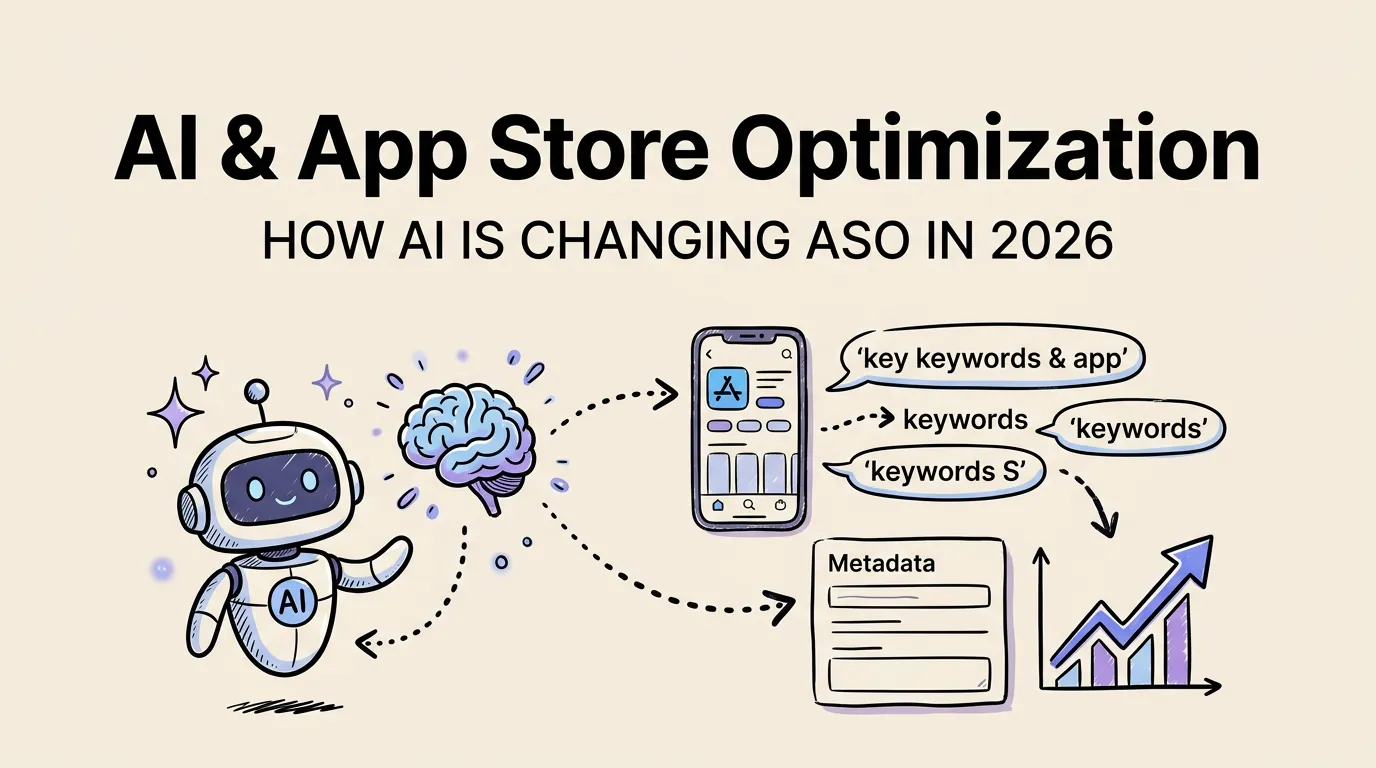
Two years ago, AI-powered ASO meant plugging keywords into ChatGPT and hoping for the best. In 2026, AI is embedded in every stage of the optimization pipeline: researching keywords, generating captions, localizing metadata, analyzing competitors, and even designing screenshots.
But the hype around AI in ASO often outpaces the reality. Some applications genuinely save hours of work and produce better results than manual effort. Others generate plausible-sounding output that will actually hurt your rankings if you use it uncritically.
This guide covers exactly where AI helps, where it falls short, and how to use it effectively across every ASO workflow. No hype, no buzzwords, just practical applications and honest limitations. For the broad ASO strategy that AI plugs into, see our complete ASO guide.
AI for Keyword Research
Keyword research is one of the strongest use cases for AI in ASO. AI excels at generating keyword ideas, finding semantic relationships, and expanding seed lists into comprehensive keyword maps.
What AI Does Well
| Capability | How It Helps | Quality |
|---|---|---|
| Seed expansion | Generates 100+ related keywords from a single seed term | High |
| Semantic grouping | Clusters keywords by intent and topic | High |
| Long-tail discovery | Finds multi-word variants humans often miss | High |
| Cross-language suggestions | Suggests equivalent terms in other languages | Medium-High |
| Competitor keyword inference | Analyzes competitor listings and suggests their likely targets | Medium |
Example: Give an AI model your app description and it can generate a prioritized list of 50-100 keyword suggestions, grouped by theme, in under a minute. This would take a human researcher 2-4 hours.
What AI Gets Wrong
AI does not have access to actual App Store search volume data. It can suggest keywords that sound relevant but have zero search volume. And it can miss niche terms that real users actually search for because those terms do not appear frequently in its training data.
Always validate AI keyword suggestions against actual search volume data from an ASO tool or Apple Search Ads. AI generates the candidates; you need real data to evaluate them.
| AI Strength | AI Weakness |
|---|---|
| Generating keyword ideas | Estimating search volume |
| Finding semantic relationships | Assessing keyword difficulty |
| Expanding seed lists | Understanding current ranking landscape |
| Cross-language equivalents | Knowing App Store-specific quirks |
For the full keyword research process (where AI suggestions feed in), see our keyword research guide.
AI for Caption Generation
Screenshot captions need to accomplish two things: convince users to install and contain keywords for Apple’s OCR indexing. AI is remarkably good at generating captions that do both.
How AI Caption Generation Works
Modern AI models (like Gemini, Claude, and GPT-4) can take your app’s features, target keywords, and competitor captions as input and generate multiple caption variants that:
- Highlight key benefits in concise language
- Naturally incorporate target keywords
- Match a specified tone (professional, playful, direct)
- Fit within screenshot design constraints (character limits, readability)
- Vary across screenshots to cover different features and keywords
Screenshot Lab uses this exact approach: its AI analyzes your app, your competitors, and your target keywords to generate OCR-optimized captions automatically. The result is captions that serve both users and the algorithm.
Caption Quality Comparison
| Approach | Time | OCR Optimization | Conversion Focus | Cost |
|---|---|---|---|---|
| Manual writing | 2-4 hours | Depends on skill | Depends on skill | Free (your time) |
| Generic AI prompt | 5 minutes | Low (not targeted) | Low (generic) | Low |
| AI with keyword context | 15 minutes | High | Medium-High | Low |
| Specialized AI tool (e.g., Screenshot Lab) | 2 minutes | Very High | High | Tool subscription |
| Professional copywriter | 1-2 days | Medium | High | $200-500 |
The sweet spot for most indie developers is using AI with keyword context: provide the AI with your target keywords, top competitor captions, and your app’s unique selling points, then edit the output for accuracy and brand voice.
For more on writing effective captions, see our screenshot caption guide.
AI for Localization
App Store localization has traditionally been one of the most painful ASO tasks. You need keyword research, cultural adaptation, and translation quality for each market. AI has dramatically reduced the effort required.
AI Localization Capabilities
| Task | AI Performance | Human Performance | AI + Human |
|---|---|---|---|
| Direct translation | Good | Excellent | Not needed |
| Cultural adaptation | Moderate | Excellent | Best results |
| Keyword research per locale | Good for major languages | Better for niche markets | Best results |
| Caption localization | Good | Excellent | Best results |
| Metadata optimization | Moderate | Good | Best results |
The key distinction: Translation and localization are different. AI is good at translation (converting words from one language to another). It is mediocre at localization (adapting the message, cultural references, and keyword strategy for a specific market).
Best practice: Use AI for the first draft of localized metadata and captions, then have a native speaker review and adjust. This cuts localization time by 60-70% while maintaining quality.
ASO-Aware Localization
Standard translation ignores keyword optimization. “Track Your Budget” translated to Japanese is accurate but may not contain the search terms Japanese users actually use.
ASO-aware AI localization considers:
- Target keywords in the destination market
- Local search volume and competition
- Cultural preferences in app messaging
- Formatting conventions (some languages run longer than English)
Screenshot Lab’s AI localization feature handles this automatically: it generates captions that are not just translated but optimized for each locale’s search behavior. For the full localization playbook, see our screenshot localization guide.
AI for Competitive Analysis
Understanding what your competitors do well (and poorly) used to require hours of manual research. AI can now analyze competitor listings, extract patterns, and surface actionable insights in minutes.
What AI Can Analyze
| Input | AI Output | Accuracy |
|---|---|---|
| Competitor screenshots | Design patterns, caption themes, feature emphasis | High |
| Competitor descriptions | Value proposition analysis, feature comparison | High |
| Competitor reviews | Common complaints, feature requests, sentiment trends | Very High |
| Competitor metadata changes | Strategy shifts, keyword targeting changes | Medium |
| Category-wide patterns | Best practices, design trends, messaging patterns | High |
Review Analysis at Scale
This is one of AI’s strongest competitive analysis applications. Manually reading 500 competitor reviews to extract themes is impractical. AI can process thousands of reviews and return:
- Top 10 praise themes (what users love)
- Top 10 complaint themes (opportunities for differentiation)
- Feature requests (unmet needs in the market)
- Sentiment trends over time (is the competitor improving or declining?)
- Specific pain points you can address in your screenshots
Example output: “65% of negative reviews for [Competitor] mention slow load times. 22% mention missing offline support. Your screenshots should emphasize ‘Lightning Fast’ and ‘Works Offline’ as differentiators.”
For how this intelligence translates into screenshot strategy, see our screenshot examples by category guide.
AI for Screenshot Design
AI-assisted screenshot design is the newest frontier. While AI is not yet designing complete screenshots autonomously, it is making the design process significantly faster and more data-driven.
Current AI Design Capabilities
| Capability | Maturity | Tools |
|---|---|---|
| Layout suggestions based on category best practices | Moderate | Screenshot Lab, some design tools |
| Color palette extraction from app icon/UI | High | Screenshot Lab, various tools |
| Template selection based on app category | Moderate | Screenshot Lab |
| Background generation | High | Midjourney, DALL-E, integrated tools |
| Caption placement optimization | Moderate | Emerging feature |
| Full screenshot generation from app screenshots + prompts | Early | Screenshot Lab (template-based) |
What works today: AI that takes your raw app screenshots, extracts colors from your app’s UI, suggests a template that fits your category, and generates OCR-optimized captions. The human still makes design decisions, but AI handles the tedious parts.
What does not work yet: Fully autonomous screenshot design where you upload your app and AI generates production-ready screenshots without human input. The output quality is inconsistent, and the risk of a bad listing is too high.
For the tools that combine AI with screenshot design, see our screenshot tools comparison.
AI for A/B Testing
AI is starting to influence how A/B tests are designed and analyzed:
Test Design
AI can suggest what to test based on:
- Analysis of your current screenshots vs. category best practices
- Competitor comparison (what are they doing differently?)
- Historical test results from similar apps
- Conversion rate benchmarks for your category
Result Analysis
AI can interpret test results faster than manual analysis:
- Statistical significance assessment
- Segment-level insights (does the winning variant perform differently by geography?)
- Recommendations for the next test based on learnings
For A/B testing fundamentals, see our screenshot A/B testing guide.
Current Limitations of AI in ASO
Being honest about what AI cannot do is as important as knowing what it can:
Limitation 1: No Access to Real-Time App Store Data
AI models do not have live access to App Store search volume, rankings, or conversion data. They work with patterns and probabilities, not current facts. Always validate AI suggestions against real data from ASO tools or App Store Connect.
Limitation 2: Hallucination Risk
AI can generate plausible-sounding but factually wrong information. “This keyword has high search volume” from an AI model is a guess, not a measurement. Treat AI output as suggestions to evaluate, not facts to act on.
Limitation 3: Generic Output Without Context
Generic AI prompts produce generic results. “Write 10 screenshot captions for my fitness app” will give you captions that sound like every other fitness app. You need to provide specific context: your unique features, target keywords, competitor analysis, and brand voice.
Limitation 4: Cultural Nuance
AI localization is improving but still struggles with cultural nuance, local slang, and market-specific messaging conventions. A native speaker review remains essential for any market where you are serious about growth.
| AI Stage | Reliability | Human Oversight Needed |
|---|---|---|
| Keyword brainstorming | High | Validate with real data |
| Caption first drafts | High | Edit for brand voice and accuracy |
| Translation | Medium-High | Native speaker review |
| Competitive analysis | High | Verify key claims |
| Design suggestions | Medium | Designer makes final decisions |
| Strategy recommendations | Medium | Cross-reference with real performance data |
What Is Coming Next
The AI-ASO integration is accelerating. Here is what we expect in the next 12-18 months:
- Automated keyword rotation - AI monitors rankings in real time and suggests keyword swaps when opportunities emerge or competition shifts
- Predictive conversion modeling - AI predicts which screenshot designs will convert better before you test them, based on patterns from thousands of listings
- Dynamic localization - AI adapts your listing in real time for different markets based on seasonal trends and local events
- End-to-end screenshot generation - Upload your app screenshots, describe your value proposition, and get production-ready App Store screenshots
- Integrated optimization loops - AI tools that connect to App Store Connect, make changes, measure results, and iterate autonomously
For staying current on screenshot automation specifically, see our screenshot automation guide.
How to Start Using AI for ASO Today
Here is a practical starting workflow:
- Keyword research: Use AI (ChatGPT, Claude, Gemini) to generate 50+ keyword suggestions from your app description. Validate the best candidates with an ASO tool.
- Caption generation: Feed your target keywords and competitor captions into AI. Generate 3-5 caption variants per screenshot. Edit the best ones for your brand voice.
- Localization: Use AI for first-draft translations of your metadata and captions. Have native speakers review before publishing.
- Competitive analysis: Paste competitor reviews into AI and ask for theme analysis. Use the insights to differentiate your screenshots and messaging.
- Iteration: After each update cycle, analyze results and use AI to suggest the next round of optimizations.
The developers who win at ASO in 2026 are not the ones who avoid AI or the ones who blindly trust it. They are the ones who use AI as a force multiplier for their human judgment.
Frequently Asked Questions
Will AI replace the need for ASO expertise? No. AI is a tool, not a strategist. It accelerates research, generates options, and automates repetitive tasks. But it still requires human judgment to evaluate suggestions, make strategic tradeoffs, and understand the nuances of your specific market and users. Think of AI as a research assistant, not a replacement for ASO knowledge.
Which AI model is best for ASO tasks? There is no single best model. GPT-4 and Claude are strong for keyword brainstorming and caption writing. Gemini integrates well with Google’s ecosystem. For most ASO tasks, the differences between top-tier models are marginal. What matters more is the quality of your prompt: the more context you provide (keywords, competitors, brand voice, constraints), the better the output.
Is AI-generated content penalized by Apple? Apple has not announced any policy against AI-generated metadata or captions. However, if AI produces content that violates Apple’s guidelines (keyword stuffing, misleading claims, etc.), that content will be rejected regardless of how it was created. The responsibility is on you to review AI output before submission.
How much time does AI actually save in ASO workflow? Based on our experience, AI reduces keyword research time by 50-60%, caption writing time by 60-70%, and localization time by 60-70%. The total time saved depends on how many markets you target and how frequently you update. For a typical indie developer doing monthly ASO updates, AI can save 4-8 hours per cycle.